- Mark Lind
- Mar 15

Updated: May 29
opening the sketchbook
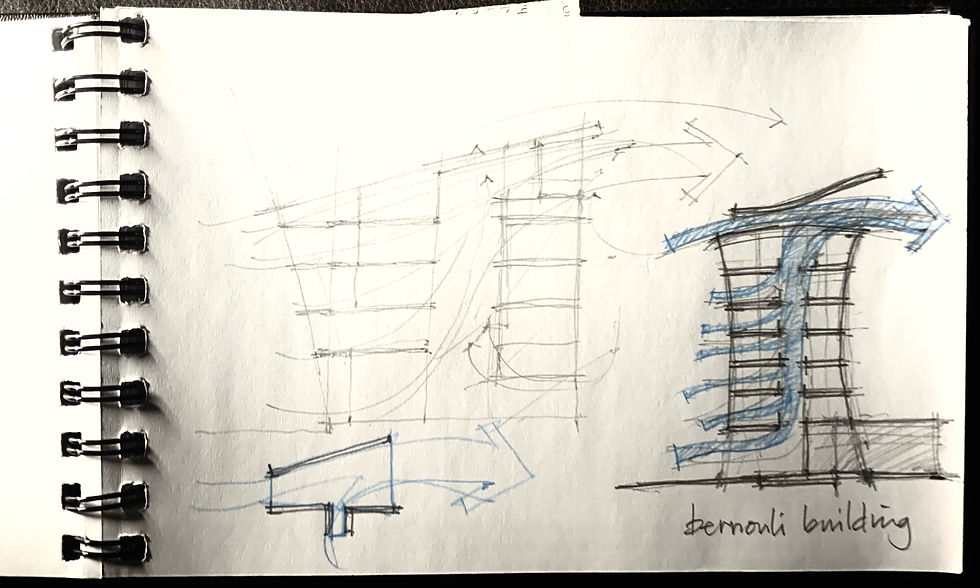
INTRO When I taught freehand perspective drawing in grad school, I gave my architecture students an unusual assignment: go outside and draw trees and clouds. If you can draw complex shapes like these, you can draw just about anything ! During the exercise I asked students to focus on drawing what they actually saw,
not some stereotype about how they thought trees and clouds were supposed to look. That led to a discussion about the difference between looking and seeing. Looking is primarily a physical act: your eyes focus on an object. Seeing on the other hand, is something different: it's a cognitive process whereby your brain interprets what you're looking at and begins to understand its internal structure and form. Lots of people look at things; fewer people actually see them.
Turns out, this same sentiment is contained in a quote by Henry David Thoreau, who said, “It’s not what you look at that matters, it’s what you see.” As I had done with my students, Thoreau encourages us to find a deeper meaning or beauty, rather than accepting surface-level appearances….
Sketching is one way that we train ourselves to see-- to see the world as it really is, not what we want or expect it to be.
________________________________________________________________________________
THE SKETCHBOOK
Architects used to carry a sketchbook with them wherever they went, jotting down ideas and drawing up concepts or details as quick, small-scale images. Sketchbooks aren't meant to be filled with finished presentation drawings; they're notebooks used primarily for recording ideas. They convey concepts using simplified drawings that focus on a single subject or some fleeting observation.
Sketches are, by nature, usually quick and imperfect, but that's what makes them valuable: they capture thoughts and communicate them efficiently with as few words as possible. Because of this, sketchbooks often reveal more about what artists, architects, and designers are thinking than anything else. Ultimately, sketching isn't really just about drawing; it's about seeing the world around us and communicating these observations in concise, visual form.
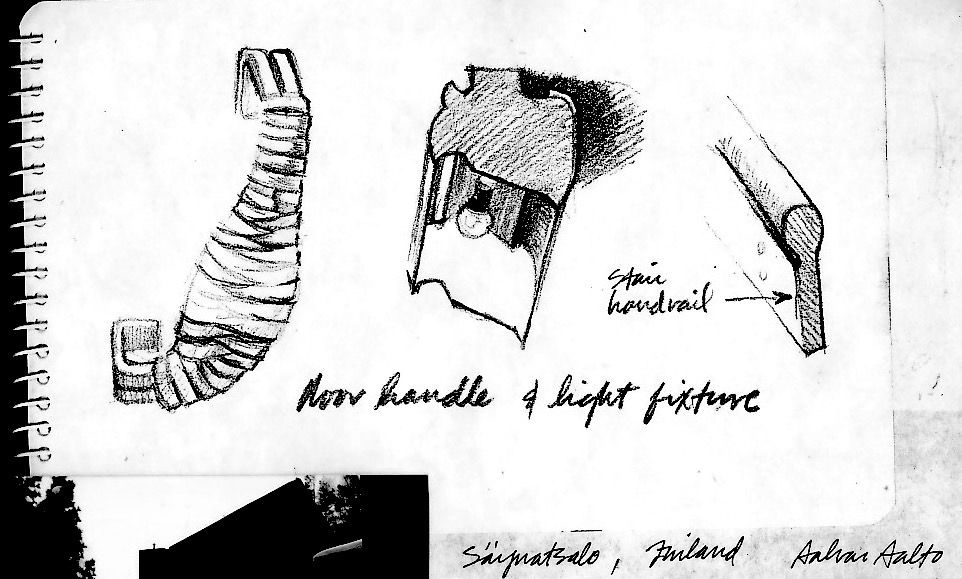
When I was studying architecture in Copenhagen, Denmark, keeping a sketchbook was an essential part of learning to see buildings carefully. I carried mine every-where, along with two pencils, one eraser, and a pair of gloves that had holes cut in the tips of the right thumb and index finger so I could sketch outdoors in the cold. Needless to say, the more I sketched, the faster and better I got at it. The freezing weather of Scandinavia in winter was the best teacher I could have ever had !
Keeping a sketchbook taught me to notice things that photographs often miss, and to see them as they really are. These daily sketches trained me to see the world more deeply, to notice the subtle details that make something special, and to capture the ideas behind them using only a pencil.
This blog is a continuation of that process. Like a sketchbook, it's a place to record ideas about architecture and design-- sometimes prompted by buildings I've visited, sometimes by projects I've worked on, and sometimes by a recurring thought that refuses to go away until it's been put down on paper.
Like any good sketchbook, the entries here will be spontaneous and focussed, with each "sketch" exploring a different topic about architecture, good design, hot jazz, cold tequila, and how these observations enhance the way that we see and understand the world around us.

check back frequently for my latest sketch ...